
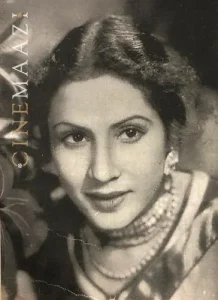
 Khursheed Bano (born Irshad Begum; April 14, 1914 – April 18, 2001), commonly referred to as Khursheed or Khurshid, was a pioneering singer-actress of early Indian cinema, celebrated for her influential career during the 1930s and 1940s. Born in Lahore, British India, she grew up in a multilingual environment, speaking Urdu, Persian, English, and Punjabi. Despite family restrictions on formal music training, she developed her vocal talents through her work in films.
Her career began in 1931 at Madan Theatres in Calcutta, where she made her debut under the screen name Shehla in films such as Laila Majnu and Eye for an Eye. She quickly transitioned from silent films to talkies, gaining recognition for her role opposite Prithviraj Kapoor in Swarg Ki Seedhi (1935). That same year, she starred in Ishq-e-Punjab, considered the first Punjabi talkie. After relocating to Bombay, Khursheed worked with several studios, including Saroj Movietone, delivering a series of films where she often performed all the songs herself, such as in Gaibi Sitara (1935).
Khursheed’s career reached its zenith at Ranjit Movietone, where she collaborated with music director Khemchand Prakash and actor Motilal in hits like Holi (1940), Pardesi (1941), and Shadi (1941). Her most legendary work came opposite the celebrated singer-actor K. L. Saigal in Bhakt Surdas (1942) and the musical masterpiece Tansen (1943). In Tansen, she played the role of Tani, and her duets with Saigal, along with her solo performances, became iconic. Her powerful and melodious voice, featured in songs like “Barso Re” from Tansen and “Panchhi Bawra” from Bhakt Surdas, solidified her status as a top singer-actress. Other notable films from this period include Shahenshah Babar (1944), Mumtaz Mahal (1944), and Aage Badho (1947) with a young Dev Anand.
As a singer, she was renowned for her collaborations with composers like Khemchand Prakash, Gyan Dutt, and Bulo C. Rani. Her memorable songs include “Ghir Ghir Aaye Baderia” (Shadi), “Jo Hum Pay Guzarti Hai” (Mumtaz Mahal), and “Meri Bintee Suno Bhagwan” (Aap Beeti).
Following the partition of India in 1947, Khursheed migrated to Pakistan in 1948. Her film career there was short-lived, with two commercially unsuccessful films, Fankaar and Mandi, both released in 1956. She subsequently retired from the film industry. After a first marriage to actor Lala Yakub ended in divorce, she married Yusuf Bhai Mia in 1956 and settled into a private life in Karachi, focusing on her family and philanthropic work. She consistently declined to discuss her film career after retirement.
Khursheed Bano passed away in Karachi on April 18, 2001, at the age of 87. She is remembered as a trailblazer who significantly influenced later artists, such as Suraiya and Noor Jehan, leaving an indelible mark on the golden age of Indian cinema.