
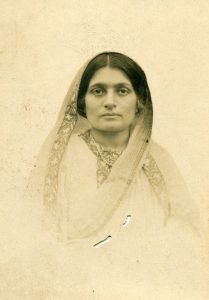
 Born Amina Najmuddin Tyabji in 1878, Lady Amina Hydari (1878-1939) came from one of the most distinguished Muslim families in British India. Her father was the Oriental scholar Haji Mulla Najmuddin Tyabji, and her uncle was the eminent jurist and freedom movement leader Badruddin Tyabji, who served as the third President of the Indian National Congress and was the first Muslim to hold that office. This family background — steeped in civic engagement, progressive thought, and a commitment to education that extended conspicuously to women — profoundly shaped the woman she would become.
In 1893, Amina married her cousin Sir Akbar Hydari, who would rise to become one of the most powerful administrators in Hyderabad State, eventually serving as the President of the Nizam’s Executive Council. The marriage united two eminent lineages and gave Amina both a platform and a steadfast partner for the social causes she would champion throughout her life. Far from a ceremonial consort, she became, in the words of those who recorded her legacy, her husband’s right hand in social and educational work.
Her public life came into dramatic focus on 28 September 1908, when the Great Musi Flood devastated Hyderabad, killing an estimated fifteen thousand people and destroying tens of thousands of homes along the banks of the Musi River. Despite being pregnant at the time, Amina plunged into the relief effort, organising rescue operations and assisting in the rehabilitation of flood victims. Her response drew widespread recognition, and later that year she was awarded the Kaisar-i-Hind Medal by the British Raj — becoming the first woman ever to receive this prestigious honour for social work. The medal acknowledged not only her courage during the disaster but the broader spirit of public service that defined her character.
Even before the flood, Amina had already turned her energies to a cause that would become the enduring pillar of her legacy: the education of girls. In 1907, she collaborated with other reform-minded women, including the poet and nationalist Sarojini Naidu, to persuade the Nizam of Hyderabad to sanction and support a school dedicated entirely to female education. The result was the Mahboobia Girls’ School, the first institution of its kind in Hyderabad State. In a society where female education faced deep social and cultural resistance, especially for Muslim women, the founding of this school represented a genuine act of defiance — one that opened doors that had long been shut. The school continues to function today, a living monument to its founder’s vision.
Amina Hydari’s commitment to women extended beyond formal schooling. She recognised that education alone could not transform women’s lives without also creating spaces where they could meet, exchange ideas, and participate in the social world on equal terms. To that end, she established the Lady Hydari Club in 1929, housed in a purpose-built structure in the Bashir Bagh area of Hyderabad designed by the architect Zain Yar Jung. The club grew out of the Hyderabad Ladies’ Association, which had been formed at the turn of the century to facilitate socialising among elite Hyderabadi and British women. The 1929 building, however, gave this enterprise a permanent and architecturally distinguished home. Thoughtfully designed with the cultural realities of the time in mind, it featured a semi-circular entrance that allowed purdah-observing women to arrive by car and enter without being seen by men — a detail that reflected Amina’s practical understanding of the barriers she needed to lower, not simply argue against. The club brought together women from both Indian aristocratic circles and the British community, offering space for tennis, social gatherings, and programmes of broader educational and civic value. It became a venue of such repute that in 1952 — more than a decade after its founder’s death — Eleanor Roosevelt spoke there at a conference of social workers.
Amina Hydari also extended her personal attention to the two Ottoman princesses who married into the Nizam’s household in 1931: Princess Dürrüşehvar, who wed Azam Jah, and Princess Nilüfer, who wed Prince Muazzam Jah. As these young women settled into the unfamiliar world of Hyderabadi court life, Amina is said to have taken them under her educational guidance.
Lady Amina Hydari died in 1939 at the age of sixty-one. Her name lives on in the club she founded, in the school she helped bring into existence, and in the memory of a woman who met one of the worst natural disasters of her era with courage, and spent the remainder of her life ensuring that future generations of women would have more choices than she herself had been born into.