
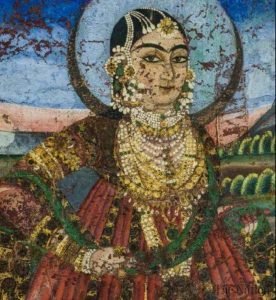
 Mah Laqa Bai Chanda (1768-1824), born Chanda Bibi, was a remarkable and influential figure in 18th and 19th-century Hyderabad, transcending the constraints of her era to become a celebrated poet, skilled warrior, diplomat, and philanthropist. As a powerful courtesan in the court of two Nizams, Mir Nizam Ali Khan and Sikandar Jah, she wielded unprecedented political influence, advised on matters of statecraft, and became the first woman to be awarded the rank of omarah, the highest nobility.
Born in Aurangabad to a courtesan mother and a Mughal military official, Mah Laqa Bai was adopted by her aunt, a prominent courtesan in Hyderabad. This upbringing provided her with access to an elite education typically reserved for noblemen. She received rigorous training in literature, music, and dance, while also mastering archery, horseback riding, and javelin throwing. Her intellectual pursuits were nurtured in a vast library, where she studied Persian, Urdu, and Hindu philosophical texts, laying the groundwork for her multifaceted career.
Her most enduring legacy is her poetry. As the first woman in Urdu literary history to have a published diwan (a complete collection of poems), titled Gulzar-e-Mahlaqa, she was a literary pioneer. Her ghazals are noted for their simplicity, directness, and a distinctly feminine voice that challenged the prevailing masculine norms of Urdu poetry. Blending the regional idioms of Dakhani Urdu with classical Persian meters, her work was both accessible and profound. Deeply influenced by Sufi mysticism, her verses often employed spiritual allegories to convey both divine and earthly passion. As a Shi’a Muslim, her devotion to Imam Ali was a central theme, and she was a prominent figure during Muharram observances.
Mah Laqa Bai’s talents were not confined to the literary arts. A formidable warrior, she accompanied the Nizam into three battles dressed in male attire, showcasing exceptional skill in archery and spear-throwing. Her diplomatic acumen was equally impressive, as she played a crucial role in negotiations with the Marathas and the British, using her cultural fluency to forge alliances and advise on state policy.
A generous philanthropist, Mah Laqa Bai used her immense wealth to support the arts and champion women’s empowerment. She established a cultural centre that trained hundreds of girls in music, dance, and literature and donated a considerable fortune toward girls’ education. Upon her death, she bequeathed her entire estate—including land, jewels, and gold—to homeless women. The land on which parts of Osmania University now stand was originally part of her jagir (land grant).
Never married, she commissioned a magnificent tomb complex for herself at Moula Ali, a blend of Mughal and Rajasthani architectural styles, where she is buried next to her mother. Mah Laqa Bai Chanda’s life defied categorisation; she was a polymath who excelled as a poet, stateswoman, and patron of the arts, leaving an indelible legacy of resilience, creativity, and female empowerment in South Asian history.