
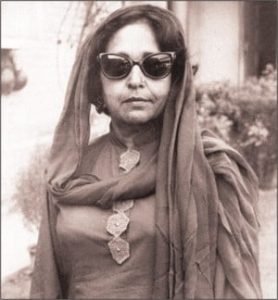
 Malika Pukhraj (1912–2004) was a legendary ghazal and folk singer celebrated across the Indian subcontinent for her expressive singing and iconic repertoire. Born in Hamirpur Sidhar, near Akhnoor in Jammu and Kashmir, to a family of musicians, she was named “Malika” (queen) by a local spiritualist and “Pukhraj” by her aunt. Her early life was marked by upheaval but also by resolute support from her mother, who was determined that her daughter would rise to national fame.
Pukhraj received intensive classical training under Ustad Ali Baksh Kasuri, the father of prominent vocalist Bade Ghulam Ali Khan. By age nine, after impressive local performances and training in music and dance, she was invited to sing at the coronation of Maharaja Hari Singh, the last ruler of Jammu and Kashmir. The Maharaja, awed by her talent, appointed her as the official court singer—a position she held for nine years. Her time at the royal court was marked by close interaction with the princely elite and significant professional growth.
Intrigue and political unrest eventually forced her to leave Kashmir. She moved with her family to Lahore, where, even before the Partition, she established herself further. After 1947, Pukhraj migrated to Pakistan and quickly gained popularity as a prominent voice on Radio Pakistan, primarily through memorable collaborations with composer Kale Khan. Her repertoire covered thumri, dadra, bhajan, and especially Pahari (hill folk) and Dogri songs, showcasing her roots and versatility.
Malika Pukhraj’s enduring signature song is “Abhi to Main Jawan Hoon,” a nazm by Hafeez Jalandhari, which she first performed in her teenage years and which has remained associated with her for life. This song remains a celebrated and cherished favourite among listeners in both India and Pakistan. Other memorable songs include “Lo Phir Basant Aayi” and “Mere Qatil Mere Dildar Mere Paas Raho”.
Beyond singing, Pukhraj contributed to Pakistan’s nascent film industry. She briefly ran Malika Studio in Lahore and produced the film “Shimmi” (1950). Her professional achievements included receiving Pakistan’s prestigious Pride of Performance Award in 1980 and, in 1977, the “Legend of Voice” award from All India Radio during its Golden Jubilee celebrations—a rare cross-border honour reflecting her unique stature.
Pukhraj married Syed Shabbir Hussain Shah, a government officer and writer, and had six children. Among them, her daughter Tahira Syed became a celebrated singer, known for reviving her mother’s classics and folk songs.
Malika Pukhraj’s long career—spanning over eight decades—was distinguished by her remarkable independence, integrity, and command over classical and folk idioms. Her autobiography, titled “Bezubani Zuban Na Ho Jaye” (published in English as “Song Sung True”), offers a candid look at her extraordinary journey, her times at the royal court, and her convictions, providing a rare and vivid record of the era and her own indomitable spirit.
She passed away in Lahore in 2004, revered as an artist who not only preserved traditional forms but also bridged cultures and generations with her voice and artistry.