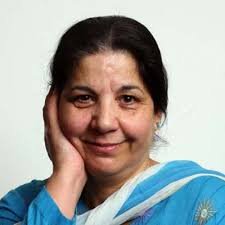
 Nayeema Ahmad Mahjoor is a distinguished Kashmiri journalist, fiction writer, and social activist whose career spans from local Kashmiri radio to the international platform of the BBC World Service. Her work, both in journalism and literature, has focused on issues of conflict, identity, and women’s rights in South Asia, making her a significant voice in the region’s discourse.
Born in Srinagar, Kashmir, Mahjoor grew up in a privileged and progressive family. Her father, a Financial Services Administrator, ensured she and her sisters received a quality education. This strong educational foundation was further solidified by her marriage to Abdal Ahmad Mahjoor, the son of the renowned Kashmiri poet Peerzada Ghulam Ahmad Mahjoor. This literary lineage has had a profound impact on her own writing and cultural perspective.
Mahjoor’s educational background is diverse and comprehensive. She holds a Bachelor of Law and a Master’s in Urdu from the University of Kashmir. She also earned a Master’s in Politics and Governments of South Asia from the University of London, a degree that helped her transition from a local to a global perspective.
Her professional career began in her early twenties as an announcer and news bulletin reader for the popular Kashmiri radio program “Zoondub” at Radio Kashmir, where she was affectionately known as “Nun Koor.” She then spent five years as a Programme Executive at All India Radio before her most notable professional period with the BBC World Service in London. For over 22 years, she held various roles, including Producer, News Editor, and Desk Editor for the BBC Urdu Service. During her time at the BBC, she created acclaimed documentaries such as “Three Generations of Women After 1947 in the Subcontinent” and “Nomads of India” and conducted interviews with influential leaders like General Pervez Musharraf, Benazir Bhutto, and Dr. Manmohan Singh.
Mahjoor’s literary contributions are rooted in her experiences and observations of Kashmir’s tumultuous history. Her debut novel, Lost in Terror (2016), published by Penguin Random House, is set during the late 1980s uprising in Kashmir. It tells the story of a young, educated woman caught in the conflict. Her Urdu novel, Dahshatzadi (2007), is an autobiographical work that explores the painful realities of a Kashmiri family’s life during the conflict that began in 1989. In Beyond Silence: Women’s Stories (2022), she highlights the experiences of Kashmiri women who have been forced to take on unimaginable roles amid decades of political turbulence. She has two upcoming publications: a historical fiction novel titled “Unbecoming” and an Urdu work called “Kashmir Diary.”
Beyond her professional and literary endeavours, Mahjoor has been politically engaged and a social activist. She joined the People’s Democratic Party (PDP) in 2014 and was appointed as a Media Advisor. In 2015, she became the Chairperson of the Jammu and Kashmir State Commission for Women (SCW), a position she held until 2018. During her tenure, she championed women’s rights and addressed gender-based issues in the region. She resigned from the position after the collapse of the PDP-BJP coalition government, stating that she was “a non-political person” and could not work in a “rotten political system.”
Today, Mahjoor splits her time between Kashmir and London. She is an independent columnist for The Independent Urdu (UK) and a regular contributor to various publications, including The News International and Greater Kashmir. She also works as a political analyst specialising in South Asian affairs and immigrant issues and remains an active commentator on social media regarding Kashmir-related topics.
Nayeema Ahmad Mahjoor’s legacy is defined by her pioneering work in international broadcasting, her authentic portrayal of Kashmir’s struggles through literature, and her dedicated advocacy for women’s rights. Her journey from local radio to international media and her commitment to giving a voice to the marginalised have made her a significant figure in contemporary South Asian intellectual and cultural life.