
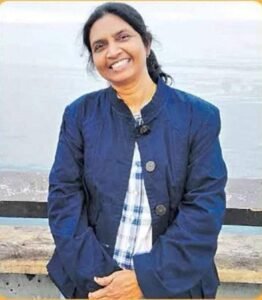
 Nigar Shaji is a distinguished Indian aerospace engineer and celebrated space scientist currently serving as the Programme Director for Low Earth Orbit (LEO) and Planetary Missions at the Indian Space Research Organisation (ISRO). Simultaneously holding the position of Associate Director at the U R Rao Satellite Centre (URSC), she is responsible for overseeing the architecture of India’s future interplanetary endeavours, including missions to Venus and the development of the Bharatiya Antariksh Station.
She achieved global prominence as the Project Director of Aditya-L1, India’s inaugural solar observatory, successfully steering the mission from conceptualisation to its precise orbital insertion at the Sun-Earth Lagrange Point 1 (L1) in 2024.
Born Nigar Sultana in 1964 in the agrarian town of Sengottai in the Tenkasi district of Tamil Nadu, Shaji’s journey was shaped by a household that prioritised intellectual rigour. Her father, Sheikh Meeran, was a mathematics graduate who turned to farming; he actively cultivated a scientific temperament in his children by sharing narratives of great scientists, with Marie Curie serving as a pivotal role model for the young Shaji.
She did her schooling from the SRM Government Girls Higher Secondary School, Sengottai, where she was a district and school topper. She completed her Bachelor of Engineering (B.E.) in Electronics and Communication from the Government College of Engineering, Tirunelveli, and her Master of Technology (M.Tech.) in Electronics from the Birla Institute of Technology (BIT), Mesra, Ranchi.
Nigar Shaji joined ISRO in 1987, beginning her career at the Satish Dhawan Space Centre (SHAR) in Sriharikota as a spacecraft test engineer. She later transferred to the U R Rao Satellite Centre (URSC) in Bengaluru, the hub of India’s satellite technology.
Key Assignments:
- Resourcesat-2A: Before moving to space science missions, she served as the Associate Project Director for Resourcesat-2A, a critical Earth observation satellite launched in 2016. In this role, she managed complex imaging payloads essential for national resource monitoring.
- Study Director for Venus (2012): Demonstrating her long-term strategic vision, Shaji served as the Study Director for India’s proposed Venus mission as early as 2012, laying the groundwork for what is now the upcoming Shukrayaan mission.
Shaji is not just an administrator but a published researcher. Her technical papers focus on image compression, space internetworking, and system engineering, addressing the critical challenges of transmitting large volumes of scientific data from deep space to Earth.
The Aditya-L1 Mission:
Shaji’s defining contribution to date is her leadership of the Aditya-L1 mission. For over eight years, she directed a team of scientists and engineers to build a 1,480 kg observatory capable of withstanding the harsh radiation environment of deep space.
* Engineering Feats: She oversaw the integration of seven complex payloads, including the Visible Emission Line Coronagraph (VELC) and the Solar Ultraviolet Imaging Telescope (SUIT).
* Orbital Precision: The mission required a precise injection into a “Halo Orbit” around L1, located approximately 1.5 million kilometres from Earth. Shaji led the team through the complex manoeuvres required to stabilise the spacecraft in this unstable gravitational zone.
Upon success, she stated, “It is a dream come true for Team Aditya-L1,” marking India’s entry into the elite group of nations capable of solar monitoring from Lagrange points.
Honours and Recognitions:
Nigar Shaji has received multiple accolades for her contributions to national development and science:
* “Eve of Excellence” Award: Presented by Tiruchirappalli Regional Engineering College (NIT Trichy).
* The Hindu Excellence Award: Specifically, the “Excellence in Education, Science, and Technology Award“.
* Amazing Indians Award (2023): Recognised by Times Now alongside Chandrayaan-3 Director P. Veeramuthuvel.
Shaji is a vocal advocate for women in science, frequently citing ISRO’s meritocratic culture. She famously remarked, “At ISRO, there is no glass ceiling… talent matters,” while encouraging women to overcome social conditioning and “sit at the front” in professional settings.