
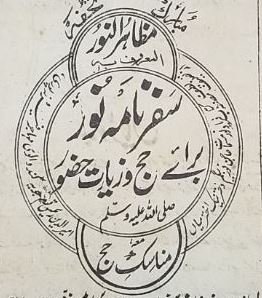
 Nur Begum, whose birth name was Ghulam Fatima, was a remarkable woman from a zamindar (landowning) family of the Jauiyah caste in a village near Abohar, Punjab, in British India. In an era when literacy and religious scholarship were overwhelmingly male domains, Nur Begum was highly educated in the Islamic sciences. She adopted the pen name Nur Begum for her literary work, most notably her account of the Hajj.
Her work stands as a rare and invaluable testament, not from royalty or the urban elite, but from a rural woman who used her intellect and faith to navigate and document her world.
In 1931, Nur Begum embarked on the Hajj pilgrimage with her mother and her husband, who is conspicuously almost absent from her written account. The journey was an arduous, three-month undertaking, far removed from the luxurious travels of her contemporaries like the royal Begums of Bhopal.
Her travel likely involved a long overland portion by camel and other means to a major port such as Karachi or Bombay. From there, she would have taken a pilgrim ship to Jeddah, the port city for Mecca. Like most pilgrims from British India, she was subject to the strict regulations of the colonial administration, including a mandatory quarantine period upon arrival in the Arabian Peninsula, a measure intended to prevent the spread of diseases like cholera. Her account details the experience of camping out and enduring the harsh conditions shared by most non-elite pilgrims, fostering a sense of a global Islamic community, or ummah, forged in shared ritual and hardship.
Nur Begum’s Hajj narrative, a lengthy Punjabi poem titled Mazahir-i Nur (Manifestations of Celestial Light/Nur), was published in 1933. It is a multifaceted work that functions simultaneously as a spiritual diary, a practical guide to Hajj rituals, a sharp-eyed sociopolitical commentary, and a powerful assertion of female spiritual and intellectual authority.
Beyond its documentary value, Mazahir-i Nur is a remarkable assertion of female agency. In a deeply patriarchal society, Nur Begum uses her profound knowledge of Islam to claim a voice and establish herself as a spiritual and intellectual authority. Her writing itself was an act of resistance, challenging the male dominance of religious scholarship and literature. She expresses frustration at the constraints placed upon women, likening herself to a “caged bird” finding freedom through the spiritual journey of the Hajj.
In contrast to the well-documented, luxurious travels of royal women like the Begums of Bhopal, Nur Begum’s narrative gives voice to the subaltern pilgrim. Her rediscovered work is a vital historical document that enriches our understanding of women’s lives, religious practice, and feminist consciousness in early 20th-century South Asia.
Nur Begum’s Mazahir-i Nur is one of the earliest known Hajj travelogues written by a woman in the Punjabi language. For decades, her work was largely forgotten, but it has been rediscovered by scholars and is now recognised for its immense historical and literary value.