
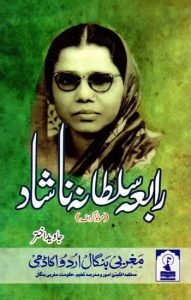
 Rabia Sultana Nashad stands as one of Bihar’s most significant Urdu poetesses of the 20th century, a notable female voice in the literary world of post-independence India. Her life and work encapsulate the aspirations and challenges faced by women in a traditional society, while making a profound contribution to the evolution of Urdu literature.
Born in 1921 in Arrah, Bihar, Nashad belonged to an educated, middle-class family. Her father, Abul Khair Mohammed Ashraf, was the headmaster of the prestigious Mohammedan Anglo-Arabic School in Patna City, a historic institution central to the educational reform movement in the region. This background placed her family within Bihar’s respected intellectual circles. Due to the prevailing pardah system, which restricted women’s public movement, Nashad was educated at home. This was a common practice, but her father’s position likely ensured she received a comprehensive and high-quality education in Urdu literature, Islamic studies, and other subjects.
Nashad’s literary career is marked by four major poetry collections: “Soz-e-dil” (Passion of the Heart), “Jazbat-e-nashad” (Emotions of Nashad), “Nasoor” (Wound), and “Toofan-e-gham” (Storm of Sorrow), published in 1966. Her work is distinguished by its use of simple, accessible language to explore complex social and psychological themes. She moved beyond traditional romanticism to depict the struggles of ordinary people, with a particular focus on the plight of women and marginalised communities. This approach aligned her with the progressive movement in Urdu literature, which sought to make art a vehicle for social commentary. Her poetry skillfully combined the classical forms of ghazal and nazm with modern sensibilities, expressing deep emotional states with lyrical grace.
Beyond her poetry, Nashad was a formidable intellectual figure. She served as the editor of the weekly Urdu publication “Memar,” a role of considerable significance for a woman in mid-20th-century India. This platform allowed her to champion Urdu literature, engage in contemporary social debates, and foster literary talent. Her commitment extended to active social work, where she advocated for educational advancement and community reform, viewing literature and social activism as intertwined responsibilities.
Nashad’s contributions were recognised with various literary awards during her lifetime. Her enduring legacy is further evidenced by the Rabia Sultana Nashad Award for Literary and Academic Excellence, presented by the West Bengal Urdu Academy, which celebrates her lasting impact. She played a crucial role in shaping Bihar’s unique literary identity, which was characterised by social consciousness and accessibility, distinct from the established traditions of Delhi and Lucknow. Her career was a landmark achievement, helping to establish a space for female voices in a literary landscape where they were exceedingly rare.
Rabia Sultana Nashad passed away in 2002, leaving behind a powerful legacy. She is remembered as a pioneering poet who bridged traditional forms with modern social concerns, using her art to give voice to the voiceless and advocate for change. Her life and work continue to inspire future generations, securing her place as a vital and influential figure in the history of South Asian literature.