
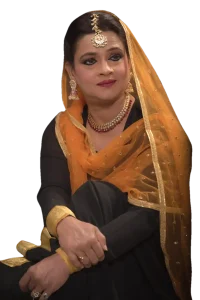
 Rani Khanam is a distinguished Kathak exponent of the Lucknow Gharana, celebrated for her pioneering work in weaving Sufi mysticism and Islamic spirituality into her performances. Beyond her artistic innovations, she is a powerful voice for social change, using her art form to address critical contemporary issues.
Born in Bihar to a conservative Muslim family with deep roots in the Chishtiya Sufi order, Khanam’s journey into dance was one of passion and perseverance. She overcame cultural barriers to pursue formal training, culminating in over a decade of rigorous study under the legendary Pandit Birju Maharaj at the Kathak Kendra in New Delhi. This strong foundation provided her with the vocabulary to embark on a unique artistic exploration.
Rani Khanam’s most significant contribution is her seamless integration of Sufiana poetry, Qawwalis, and Islamic verses into the Kathak repertoire. Drawing from her heritage, she channels the devotional ethos of Sufism through the technical framework of Kathak, creating a deeply spiritual and moving experience. She views this not as a new “Sufi Kathak” form, but as an authentic expression of faith and philosophy through the established language of classical dance.
Her choreographic work is notable for its courage and social conscience. Her production, “Black and White,” powerfully explores the rights and inner lives of Muslim women, tackling subjects such as polygamy and divorce. Another key work, “SHIVER,” addresses the stigma of HIV/AIDS in South Asia. Through these productions, Khanam has cemented her role as an artist-activist, using the stage to foster dialogue and advocate for the marginalised.
In 1996, she founded the AAMAD (Academy of Music and Dance) Dance Centre in Delhi. As its Guru and Artistic Director, she has nurtured a new generation of dancers. The academy is also renowned for its inclusive approach, particularly its pioneering work in providing dance training for differently-abled artists, including a unique dance-on-wheelchairs program. Her scholarly pursuits include research on the Persian influence on Kathak, supported by a fellowship from the Asian Cultural Council, New York.
For her immense contributions to dance, culture, and social reform, Rani Khanam has received numerous accolades. The most prestigious among them is the Sangeet Natak Akademi Award (2018), India’s highest honour for performing artists. She has also been honoured with the L’Oréal Paris Femina Women’s Award and the 5th National Women’s Excellence Award. Rani Khanam’s legacy is that of a visionary artist who has expanded the emotional and spiritual frontiers of Kathak, proving it to be a timeless and potent medium for both divine connection and social transformation.