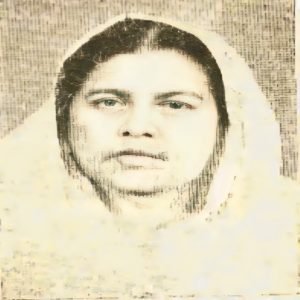
 Rashida Haque Choudhury was a pioneering Indian politician who broke significant gender and religious barriers during her career. Born on April 24, 1926, into a prominent Bengali Muslim family in Assam, she became one of only 18 Muslim women elected to India’s Lok Sabha since independence. Her father was a district magistrate during the British Raj, and she received a quality education, culminating in a Bachelor of Arts from the prestigious Lady Brabourne College in Kolkata.
In 1948, she married Moinul Hoque Choudhury, a leading figure in the Indian National Congress (INC) and a minister in Indira Gandhi’s government. This union solidified her connection to public service, and she officially joined the INC in 1950. Her political career peaked in the historic 1977 general election, which followed the controversial Emergency period. Despite a nationwide wave against the Congress party, Choudhury won the Silchar parliamentary seat with a commanding victory, securing over 138,000 votes and defeating her opponent by a margin of more than 28,000.
During her time as a Member of Parliament (1977-1979), one of her most significant contributions was her dedicated work with the Committee of Social Work for Bangladesh Refugees. The 1971 Bangladesh Liberation War had created a massive humanitarian crisis, with millions of refugees pouring into India, particularly in states like Assam. Given her Bengali heritage and her constituency’s proximity to Bangladesh, she was uniquely positioned to lead relief efforts, coordinating social welfare and care for displaced families.
Following the collapse of the Janata Party government in 1979, Choudhury aligned with a breakaway faction, the Indian National Congress (Urs). When Charan Singh formed a new coalition government, she was appointed Minister of State for Education, Social Welfare and Culture, with her portfolio later focusing specifically on Social Welfare. Though her ministerial role was brief, lasting from August 1979 to January 1980, it marked a rare achievement for a Muslim woman in Indian national politics.
Choudhury contested the 1980 election but was defeated by Santosh Mohan Dev of the resurgent INC led by Indira Gandhi. Despite this loss, her historical importance is undeniable. She stands out in a political landscape where Muslim women have been severely underrepresented; research indicates that for five parliamentary terms, there was not a single Muslim woman in the Lok Sabha. Like many of the few who succeeded, her entry was facilitated by a strong family political background.
Rashida Haque Choudhury’s legacy is that of a trailblazer. Her career exemplified the intersection of regional leadership, humanitarian service, and the complex party realignments of the 1970s. As a minister and an elected representative who served during a critical period, she carved out a distinguished place in India’s political history, paving the way for greater inclusion of women and minorities in public life.