
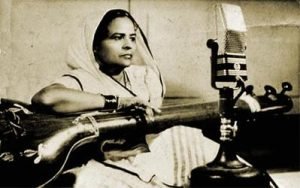
 Rasoolan Bai (1902-1974) was a legendary Hindustani classical singer and a pioneering figure of the Benaras gharana. Specialising in the romantic Purab Ang style of Thumri, she became one of the most distinguished and influential vocalists of her era, leaving an indelible mark on Indian classical music.
Born into a modest family in Mirzapur, Uttar Pradesh, Rasoolan Bai inherited a musical lineage from her mother, Adalat Bai. Her extraordinary talent was recognised at the age of five, leading to formal training under the traditional guru-shishya parampara. Her primary mentor was Ustad Shammu Khan, who hailed from the lineage of the creator of the tappa form. She also learned from noted sarangiyas (sarangi players), which gave her a profound understanding of melodic nuance.
Rasoolan Bai’s artistry was defined by her mastery of Thumri, Tappa, Dadra, and various folk forms like Kajri and Chaiti. Her unique style was characterised by the bol banao technique, which prioritises the emotional expression of the lyrics over complex melodic improvisations. Her voice, described as grainy yet intensely expressive, was perfectly suited for conveying themes of longing, unrequited love, and deep sorrow.
Her professional career spanned nearly five decades, during which she was considered the doyenne of the Benaras gharana, performing alongside other celebrated contemporaries like Siddheshwari Devi and Begum Akhtar. She was a regular performer in royal courts, private mehfils, and on All India Radio. A significant turning point in her life came in 1948 when she stopped performing in the traditional kotha setting, married a local sari dealer, and settled in Varanasi.
One of her most famous recordings is the 1935 version of “Phool Gendwa Na Maaro,” which became the subject of the 2009 documentary “The Other Song.” The film explored how the song’s original, more erotic lyrics were later sanitised, reflecting the broader cultural shifts and moral purification movements in modern India. Despite her fame, tragically few of her recordings survive today.
In recognition of her immense contribution to music, she was awarded the prestigious Sangeet Natak Akademi Award in 1957, the highest national honour for a practising artist in India.
Despite her professional success, Rasoolan Bai’s later years were filled with tragedy and hardship. During the Hindu-Muslim riots of 1969, her home in Gujarat was burned down, a traumatic event that reportedly silenced her voice forever. Alone and financially destitute, she spent her final years running a small tea stall next to the All India Radio station in Allahabad, where she had once been a star performer. She passed away in poverty in 1974, marking the end of an era. Her life story remains a poignant testament to her artistic genius and the complex relationship between art, culture, and societal change in 20th-century India.