
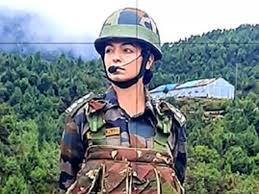
 Captain Sariya Abbasi is an Indian Army officer in the Army Air Defence (AAD) who has emerged as a visible symbol of women’s growing presence in frontline combat-support roles, particularly along the India–China border. Her service as a troop commander in a forward air defence regiment, operating upgraded L-70 guns in the sensitive Arunachal Pradesh sector, has made her a widely cited example of small-town Indian women breaking barriers in the armed forces.
Early life and education:
Sariya Abbasi hails from Ram Janki Nagar locality in Gorakhpur, Uttar Pradesh, where she was raised in a middle-class, education-oriented family that valued both learning and public service. Her father, Dr Tehseen Abbasi, is a senior broadcasting professional associated with All India Radio, while her mother, Rehana Shamim, is a junior high school teacher who also served in a leadership capacity in the school system. Growing up, Sariya was surrounded by stories of military service from relatives in uniform and frequently saw soldiers in and around her town, experiences that nurtured an early fascination with the Army and its uniform.
She completed her schooling at GN National Academy, Gorakhpur, after which she followed a conventional academic route, enrolling in a B.Tech in Genetic Engineering (Biotechnology) at IMS Engineering College, Ghaziabad. Although she had limited interest in a corporate engineering career, she excelled sufficiently to attract job offers from reputable companies in India and overseas, but she ultimately chose to decline these opportunities.
Journey to the Indian Army:
Despite her academic specialisation, Sariya consistently viewed the Army as her true calling, describing herself as emotionally attached to the idea of military service from childhood and deeply drawn to the sense of purpose and pride associated with the olive-green uniform. After leaving her early corporate jobs, she decided to prepare for the Combined Defence Services (CDS) examination conducted by the UPSC, a highly competitive route into officer training in the armed forces.
With only 12 seats for women in the relevant entry at that time, the odds were stacked against her; she did not clear the exam on her first attempt but persevered and succeeded on the second attempt, subsequently also clearing the demanding Services Selection Board (SSB) interview process. On 9 September 2017, she was commissioned into the Indian Army after passing out from the Officers Training Academy (OTA), Chennai, an event her parents attended with visible pride as she took the oath to serve the nation.
Military career and deployment:
After commissioning, Captain Abbasi joined an Army Air Defence Regiment, specializing in protection against aerial threats such as aircraft, helicopters and, increasingly, unmanned aerial vehicles (UAVs). She rose to the role of Troop Commander, responsible for leading personnel and operating sophisticated air-defence systems in challenging terrain and weather conditions. Her most widely known deployment has been in the forward areas near the Line of Actual Control (LAC) in the Tawang/Arunachal sector, a region of heightened sensitivity during periods of tension in India–China relations.
Her unit was among the first air defence regiments in the country to be equipped with upgraded L-70 anti-aircraft guns, modernized with advanced electro‑optical sights, sensors and fire-control systems that significantly enhance their anti-drone and low‑flying aircraft interception capabilities. In this context, she led a specialized anti‑drone team, operating these guns in high‑altitude conditions and demonstrating the adaptability of women officers in roles traditionally regarded as physically and technically demanding. Her presence briefing journalists at the border in October 2021, standing next to the L‑70 gun and calmly fielding questions, became an iconic image circulated across media and social platforms.
Family support and values:
Captain Abbasi frequently credits her parents for giving her the freedom to choose her path, emphasizing that neither her father nor her mother imposed their preferences regarding her education or career. Dr. Tehseen Abbasi has publicly stated that they allowed her to shape her own ambitions, while her mother’s dual role as parent and teacher provided both emotional support and academic discipline. Her younger brother, Tamsil Ahmad Abbasi, who has pursued management studies abroad, has also spoken about the pride the family takes in her achievements and the example she sets for younger relatives and peers.
The family’s outlook—combining professional accomplishment, intellectual curiosity and respect for national service—formed the backdrop against which Sariya’s aspiration for the Army could take root and flourish. This supportive environment helped her endure the uncertainties of competitive examinations and rigorous training, enabling her to transition from a small-town student of biotechnology to a frontline officer at one of India’s most sensitive borders.
Beyond her formal role, Captain Sariya Abbasi has become a symbolic figure representing the changing face of the Indian Army, particularly the integration of women in operational and technologically intensive roles. Media coverage has highlighted her as an inspiration for young women, especially those from small towns and minority communities, who see in her a tangible example of how determination and institutional support can overcome structural and social barriers. She has also been profiled in motivational and defence-education platforms, which use her journey—from rejecting lucrative corporate offers to commanding air-defence guns on the LAC—to encourage aspirants preparing for the CDS and SSB process.