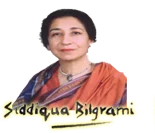
 Siddiqua Bilgrami (b. c. 1936) is a pioneering figure in South Asian abstract art, with a career spanning over six decades and three continents. Born in Hyderabad Deccan into the intellectually distinguished Bilgrami family—descendants of the Sadaat-e-Bilgram—her heritage includes figures like Nawab Syed Hussain Bilgrami, a co-founder of the All-India Muslim League. Though initially fascinated by astronomy, she turned to art at age seven, a choice that would eventually establish her as a significant voice in modernism.
Bilgrami’s formal training began at the Government College of Fine Arts in Hyderabad, where she was one of the earliest female students. Her rapid progress earned her an Italian Government Scholarship to the Accademia di Belle Arti in Rome (1958–60). In Italy, she studied sketching, etching, and ceramics, training under the abstract painter Guido La Regina. This European sojourn culminated in her first solo exhibition at Rome’s Circolo Canova in 1960. Her dedication also inspired her family; her cousin, Noorjehan Bilgrami—later a renowned textile artist—credits Siddiqua with awakening her own passion for the arts.
Upon returning to India, Bilgrami’s 1961 solo show at the Bhulabhai Desai Memorial Institute in Mumbai was inaugurated by the critic Mulk Raj Anand. She briefly served as a Technical Assistant at the Lalit Kala Akademi in New Delhi and won several prestigious awards, cementing her reputation as one of the subcontinent’s first female abstractionists.
In 1965, Bilgrami moved to Pakistan. Her debut exhibition at the Arts Council in Karachi drew significant acclaim, with one painting acquired by Zulfikar Ali Bhutto. Settling in Karachi for thirty years, she became a pillar of the Karachi Artists’ Gallery (KAG), the country’s first private art gallery. Beyond her canvas work, she introduced ceramics to the KAG and advocated for a universalist philosophy, famously stating, “Abstract art is world art,” arguing that the medium transcends geographical boundaries.
Bilgrami represented Pakistan internationally, including at the Commonwealth Art Exhibition in London (1967) and later in major retrospectives such as An Intelligent Rebellion (Paris/Bradford, 1994–96) and Pakistan: Another Vision (London, 2000). Her works are now held in permanent collections at the National Art Gallery in Islamabad and the Chandigarh Museum of Art.
After relocating to Canada, Bilgrami continued to exhibit sporadically. In 2015, she returned to Hyderabad for Landscapes of the Mind, her first solo show in her birthplace in fifty years. A 2017 exhibition at Karachi’s Chawkandi Art Gallery featured her poignant work Silent Protest, which used abstract aesthetics to explore the suffering of women in conflict zones.
Despite her extensive contributions and early prominence, Bilgrami’s name has somewhat receded from contemporary art-historical discourse. Critics like Quddus Mirza have noted her inclusion among once-celebrated artists who are now largely overlooked by mainstream narratives. A comprehensive reassessment of her oeuvre remains essential to fully understanding the trajectory of abstract art in South Asia and the vital role of women pioneers within that movement.