
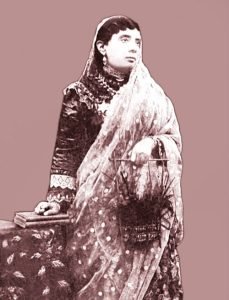
 Suhrawardiya Begum, also known as Khujista Akhtar Banu, was a trailblazing figure in the late 19th and early 20th centuries, celebrated for her tireless advocacy for women’s education and empowerment in India. She was born in 1847 into the distinguished Suhrawardy family of Midnapore, Bengal, as the eldest daughter of Ubaidullah Al Ubaidi Suhrawardy (1832–1885) and his wife Makbullan Nissa Begum. She was a direct descendant of the celebrated Sufi masters Shihab al-Din ‘Umar al-Suhrawardi and Bahauddin Zakariya Suhrawardi, and her grandfather, Shah Aminuddin Suhrawardy, is reckoned to be the last Sufi Pir of the Suhrawardiyya order in Bengal. Building on this legacy, Suhrawardiya Begum carved out her own significant role as an influential voice for progress during a pivotal time in the nation’s history.
Because no schools for girls existed in her time, Khujista was entirely homeschooled in her early years, learning Persian, Arabic, English, and Urdu directly from her father. She later graduated with honours in mathematics and Persian literature from the Indian Board of Examinations in 1887.
That year, she became the first Indian woman to pass the Senior Cambridge Examinations — the equivalent of matriculation — a milestone that placed her at the frontier of women’s education in colonial India. Following this achievement, she was appointed as an examiner for Urdu literature by Calcutta University, becoming the first and, at that time, the only Indian woman to receive such an honour from the prestigious institution.
Literary Contributions:
Beyond her work in establishing schools, Suhrawardiya Begum was also a writer who used her literary talents to advance her cause. She authored several works that centred on women’s issues and the importance of education. Through her writing, she contributed to the growing discourse on women’s rights and empowerment in colonial India, helping to bring these critical topics into the public sphere.
As a writer, Khujista authored the landmark Urdu book Aaina e Ibrat (Mirror of Admonition). The work received official recognition from Calcutta University and was incorporated into the syllabi of all its affiliated colleges, a rare distinction that cemented her standing as a serious literary and academic voice.
Social Reform & Institutional Work:
Beyond formal education, she conducted active community outreach, personally visiting the slums of Calcutta to educate marginalised communities about health and sanitation during the devastating epidemics of cholera and influenza that swept through the region in her lifetime. Khujista was deeply committed to uplifting the Indian masses. Her most enduring institutional contribution was the founding of the Suhrawardia Girls High School in Calcutta in 1909, which was inaugurated by Lady Minto (Anna Maria Amyand), the wife of the then-Viceroy of India, Lord Minto. This school represented a concrete response to the very gap in girls’ education that had once forced her own home-based instruction. This institution served as a testament to her vision, providing a vital space for girls to pursue formal education.
Marriage & Children:
In 1888, Khujista married her first cousin, Sir Zahid Suhrawardy (1870–1949), a barrister and jurist who served as a judge in the Calcutta High Court (1921–1931) and was later knighted upon retirement. The couple had two sons:
- Huseyn Shaheed Suhrawardy (1892–1963) — a lawyer and statesman who became the 3rd Prime Minister of Bengal and the 5th Prime Minister of Pakistan
- Hasan Shaheed Suhrawardy (1890–1965) — a distinguished writer and linguist
Khujista passed away in Calcutta in 1919, at the age of 47, leaving behind a legacy that spanned literary scholarship, institutional education, and grassroots social work. Her life exemplifies the transformative role played by educated Muslim women in the Bengal Renaissance — achievements that extended far beyond her celebrated Cambridge milestone.
Suhrawardiya Begum’s legacy is defined by her dedication to creating a society where women could pursue education, assert their rights, and achieve their full potential.