
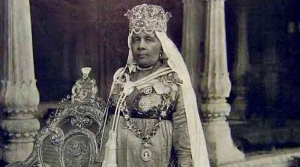
 Sultan Jahan Begum (1858–1930) was the fourth and final female ruler of the princely state of Bhopal, reigning from 1901 to 1926. Her rule marked a significant era of progressive reform, particularly in the fields of education, public health, and women’s rights, establishing her as a visionary leader in colonial India.
Born into Bhopal’s unique dynasty of female rulers, Sultan Jahan received a comprehensive education that blended Islamic and liberal studies, making her fluent in Persian, Arabic, Urdu, and English. This upbringing shaped her perspective and prepared her for leadership in a society dominated by patriarchy. When she ascended the throne in 1901, she inherited a legacy of female governance and spent her 25-year reign modernising the state’s administration and championing public welfare.
A cornerstone of her rule was her passionate advocacy for education. Sultan Jahan was a trailblazer for female education, establishing a network of primary and secondary schools for girls, including the notable Sultania Girls’ School in Bhopal. She understood the importance of a modern curriculum and integrated English and sciences alongside traditional religious instruction. Her commitment extended to higher education; she was a staunch supporter of Sir Syed Ahmad Khan’s educational movement and made history in 1920 by becoming the first and only female Chancellor of Aligarh Muslim University (AMU). Furthermore, she founded the Lady Hardinge Medical College for Women in Delhi and established training programs for nurses and midwives in her own state, recognising the critical link between education and healthcare.
Her reforms transformed public health and civic infrastructure in Bhopal. She established a network of hospitals and dispensaries, launched widespread vaccination campaigns to combat diseases like cholera and plague, and modernised the state’s municipal administration with improved sanitation and drainage systems. She actively promoted hygiene education, especially targeting women through community outreach and publications.
Sultan Jahan was also a prolific author, using her writings in Urdu and English to advocate for her reformist ideas. Works like Talim-i-Niswan (Women’s Education) and Hidayat-i-Maskinat (Guidance for Poor Women) articulated her vision for a society where women could be self-reliant and participate in public life while maintaining their cultural and religious identity. As a religious modernist, she reformed Sharia courts and encouraged a rational interpretation of Islamic principles, particularly on issues concerning women and family.
She performed Hajj in 1903, just two years after ascending the throne in 1901. This was a significant event, as it highlighted not only her personal piety and commitment to Islamic obligations but also her exceptional status as a ruling Muslim woman travelling to the Hijaz at a time when such journeys were logistically and socially difficult, especially for women.
In 1926, she abdicated the throne in favour of her son, Hamidullah Khan, ending over a century of female rule in Bhopal. She remained a prominent figure in philanthropy until her death in 1930. Sultan Jahan Begum’s legacy endures through the institutions she founded and the progressive ideals she championed. She is remembered as an enlightened ruler who skillfully balanced tradition with modernity, leaving an indelible mark as a champion of women’s empowerment and a symbol of capable female leadership in South Asia.