
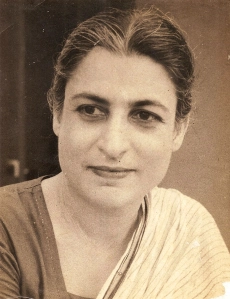
 Begum Qudsia Zaidi (23 December 1914 – 27 December 1960) was a visionary writer, theatre practitioner, and social worker whose brief but transformative career reshaped the landscape of Hindi-Urdu culture in post-Independence India. Within a span of barely twelve years, she professionalised urban repertory theatre, introduced global dramatic classics to Indian audiences, and pioneered children’s literature that blended civic education with imaginative storytelling.
Early Life and Literary Foundations
Born Umt-ul-Qudoos Abdullah in Delhi, Qudsia was the daughter of Khan Bahadur Abdullah Saheb. Following the early death of her parents, she moved to Lahore to live with her sister and brother-in-law, Ahmed Shah Bokhari (known as ‘Patras’), a celebrated Urdu humorist and broadcaster. Bokhari’s influence was formative, nurturing her literary sensibility and love for performance. After graduating from Kinnaird College, she married Colonel Syed Bashir Hussain Zaidi in 1937, a progressive union for its time. The couple lived in the princely state of Rampur until 1948, when they relocated to Delhi following the Colonel’s election to the Constituent Assembly.
In Rampur, encouraged by the educationist Dr Zakir Husain, Qudsia began writing for young readers. Her biography of Mahatma Gandhi, Gandhi Baba ki Kahani (published in English as Our Bapu with a foreword by Jawaharlal Nehru), remains a staple of children’s literature. She also adapted the comic sketches of Imtiaz Ali Taj into Chacha Chakkan ke Dramae, which became a celebrated series in Urdu children’s theatre. Her various works, including Surkh Joote and Begum Gulabo, reflected her conviction that a newly independent nation required critically minded and imaginative young citizens.
The Hindustani Theatre and Dramatic Legacy
After settling in Delhi, Qudsia’s association with cultural organiser Kamaladevi Chattopadhyay deepened her commitment to the performing arts. In 1954, alongside Habib Tanvir, she co-founded the Hindustani Theatre. By 1957, the troupe became one of the first professional urban repertory companies in independent India. Their debut featured a Hindi-Urdu rendition of Kalidasa’s Shakuntala, followed by Shudraka’s Mrichchakatika (adapted as Mitti ki Gaadi).
Qudsia was a prolific translator and adapter, rendering more than twenty world classics into accessible Urdu and Hindi. She brought the works of Henrik Ibsen (A Doll’s House), George Bernard Shaw (Pygmalion), and Bertolt Brecht (The Caucasian Chalk Circle) to the Indian stage long before they became mainstream. Her adaptations were noted for retaining the political substance of the originals while seamlessly transplanting them into an Indian social milieu. By collaborating with scholars to translate Sanskrit plays, she successfully restored classical dramaturgy to the contemporary urban stage.
Mentorship and Enduring Influence
The Hindustani Theatre served as a vital incubator for talent, mentoring figures who would later dominate Indian cinema and arts, such as filmmaker M.S. Sathyu, mime artist Irshad Panjatan, and Habib Tanvir himself. Beyond the stage, Qudsia was deeply involved in social work through the Indian Council for Child Welfare and various children’s art competitions.
Her sudden death in 1960, just days after her 46th birthday, was a profound loss to the nation’s cultural fabric. While the Hindustani Theatre did not long survive her passing, the repertoire she built continues to be performed in schools and repertories today. Begum Qudsia Zaidi remains a towering figure who bridged the gap between classical tradition and modern experimentation, embodying a progressive vision for the cultural identity of a new republic.