
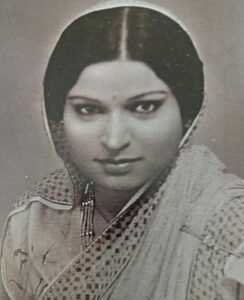
 Gauharbai Karnataki was a prominent actress, singer, and composer in early Hindi and Marathi cinema. As the elder sister of the legendary singer Amirbai Karnataki, she played a pivotal role in establishing their family’s legacy in the Indian film industry. Born in 1908 in Bilgi, Karnataka, she was the daughter of the accomplished tabla player Hussain Khan. This family background ensured that she was immersed in music from her earliest years, eventually receiving formal training in Hindustani classical music under the guidance of the respected pedagogue Nilkanth Panchakshari Buwa. Her upbringing in the linguistically diverse border regions of Karnataka and Maharashtra granted her a native-level fluency in Marathi, which would later become a cornerstone of her professional identity.
Before her entry into the world of cinema, Gauharbai and her sister Amirbai were members of the Vanivilas Natak Mandali, a prominent Kannada drama company. It was here that she mastered the “singing-actor” persona, a prerequisite for the early talkie era. Her transition to Bombay in the early 1930s was facilitated by the artist Chaphekar, who recognised her potential to cross over into films. Gauharbai quickly became a prominent artiste in the 1930s, appearing in a diverse range of films, including Sohni Mahiwal (1933) and the action-packed Chabuk Sawaar (1937), in which she acted alongside the famous Fearless Nadia. Her influence extended beyond her own stardom; she is credited with helping her sister Amirbai secure her first film role in Vishnu Bhakti in 1934, thereby launching one of the most successful playback careers in Indian history.
Gauharbai’s musical contributions were substantial. She sang over a hundred songs, encompassing Marathi natyageets, devotional bhajans, and film ghazals. She was also one of the rare female artists of her time who occasionally composed music for her productions, demonstrating a level of creative autonomy unusual for women in the 1930s studio system. Her voice was celebrated for its technical precision and emotional resonance, often being described as possessing the “Balgandharv touch.” This artistic affinity eventually led to a deep personal and professional partnership with the legendary Marathi theatre personality Bal Gandharva (Narayan Shripad Rajhans).
In 1938, she joined Bal Gandharva’s Natak Mandali, taking over the female roles that he had once famously portrayed. Their relationship blossomed into a lifelong partnership, and they eventually married in 1951. Their union was highly controversial at the time because of their differing religious and social backgrounds, leading to their alienation from traditional Maharashtrian society. Despite this, Gauharbai remained Bal Gandharva’s most devoted supporter, managing his company and caring for him until her own passing. She and Bal Gandharva collaborated to develop a unique style of devotional singing, taking the Gandharva Gayaki to common people through village concerts.
Gauharbai Karnataki passed away on March 3, 1965, the same day as her sister Amirbai, marking a poignant and synchronous end to the lives of two of the most influential sisters in Indian cultural history. Her legacy survives through the archival records of early film music, her influence on the Marathi stage, and the enduring family commitment to the arts represented by “Amir Talkies” in Bijapur. She remains a symbol of artistic resilience and a pioneer who navigated the complex transitions of early 20th-century Indian performance with grace and dedication.
Legacy
The study of Gauharbai Karnataki’s life reveals the hidden structures of the early Indian entertainment industry, where family lineage, regional theatrical training, and personal devotion intertwined to create a lasting cultural impact. Gauharbai was more than a contemporary of the early cinema; she was a bridge. She bridged the gap between the Kannada and Marathi stages, between the classical concert hall and the cinematic screen, and between the roles of a performer and a cultural steward.
Her career illustrates the radical possibilities of the 1930s, in which a woman could be a stunt-film actress, a classical vocalist, and a composer simultaneously. Her later years with Bal Gandharva, though marred by social scandal, represent a profound commitment to an artistic tradition that she helped modernise and democratise. While her recordings may be sparse, her influence is indelibly etched in the history of the Gandharva Gayaki and the successful career of her sister, Amirbai. The “Bilgi Sisters” transformed from regional performers into national icons, and Gauharbai, as the elder stateswoman of the family, was the architect of that transformation. Her story is a vital reminder of the diverse and often marginalised voices that built the foundations of the Indian cinematic and musical landscape.