
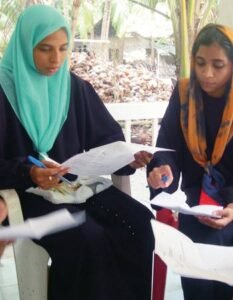
 Haseena and Tajunnisa are pioneering environmental activists and community facilitators from Agatti Island in Lakshadweep, India’s smallest Union Territory. Situated approximately 250 kilometres off the Kerala coast, Lakshadweep consists of thirty-six tiny coral islands, twelve atolls, and several reefs. These ecosystems—comprising shallow lagoons and diverse marine fauna—are among India’s most ecologically fragile environments. In the early 2000s, both women, then in their twenties, rose to national prominence for their instrumental role in mobilising the Agatti fishing community to safeguard these vulnerable marine resources.
Community-Led Conservation and the Darwin Initiative
The catalyst for their work began around 2003, when the Bombay Natural History Society (BNHS) led the International Marine Protected Area project. Funded by the Darwin Initiative, the project sought to study and protect the giant clam—classified as “vulnerable” by the IUCN—as well as baitfish and tuna populations. Recognising that top-down environmental policies often fail without local support, the BNHS aimed to establish a community-managed marine reserve. Agatti, characterised by a unique social structure that blends Islamic law with matrilineal traditions and a 100 per cent literacy rate, provided fertile ground for grassroots engagement.
Haseena, a schoolteacher, and Tajunnisa became the project’s essential bridges to the local population. Driven by the fear that ecological degradation would destroy the island’s future, they conducted door-to-door surveys to gather vital baseline data on resource use and household socio-economics. Through persistent advocacy and open-forum consultations, they successfully navigated the island’s conservative social fabric to win unanimous approval for the creation of the Agatti Conservation Reserve.
Empowering the Community through Education
Their strategy focused on demystifying marine science and integrating it with traditional knowledge. By utilising Women’s Self-Help Groups, Haseena and Tajunnisa ensured that local women were active participants in ecological monitoring and awareness campaigns. The project’s impact was tangible: ninety-five islanders were trained in giant clam and bait-fish research, while others received specialised training as divers or eco-tourism managers. This approach transformed the fishing community from resource users into active environmental stewards.
In recognition of their groundbreaking efforts, Haseena and Tajunnisa received the 2008 Earth Heroes ‘Young Naturalist’ Award in January 2009. The award, presented by Sanctuary magazine and the Royal Bank of Scotland, celebrated their ability to harmonise scientific research with community needs, securing both the ecological and economic future of the island.
The Lasting Legacy of the “Agatti Model”
The influence of their work extends far beyond the borders of Agatti. Deepak Apte, Director of the BNHS, credited the “Agatti model” established by these two women as the blueprint for all subsequent marine conservation initiatives across the Lakshadweep archipelago. This foundation was critical in May 2020, when the Lakshadweep administration announced the creation of the Dr KK Mohammed Koya Sea Cucumber Conservation Reserve at Cheriyapani reef—the first of its kind in the world. Covering 239 square kilometres, this reserve stands as a testament to the community-managed framework Haseena and Tajunnisa pioneered decades earlier. Their legacy continues to serve as a primary global example of how localised, inclusive participation is the most effective tool for long-term marine preservation.