
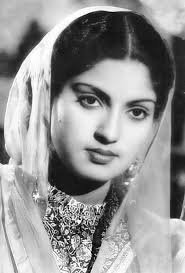
 Munawar Sultana was born in Lahore on November 8, 1924. Her father was a radio announcer, and she initially hoped to study medicine. She should not be confused with the Pakistani playback singer Munawar Sultana. Accounts differ on her earliest screen appearance: Karan Bali identifies an uncredited role in Khazanchi (1941) under the name Asha, while family recollections recorded by Shishir Krishna Sharma name Khandan (1942) as her first film role.
Her career as a leading lady began in 1945 when Mazhar Khan signed her for Rs 4,000 a month and brought her to Bombay for Pehli Nazar opposite Motilal. Sultana valued this first role above all others. The film is remembered for Mukesh’s breakthrough playback song “Dil Jalta Hai Toh Jalne Do.” By 1949, Filmindia editor Baburao Patel counted her among the industry’s most overworked leading ladies, praising her pleasant screen presence, husky voice, and expressive face in emotional scenes.
Rise to Stardom and Peak Years
The years from 1947 to 1950 marked the height of her celebrity. Sultana became closely associated with the virtuous, self-sacrificing woman—the patient wife who endures an erring husband and ultimately regains him. In A.R. Kardar’s Dard (1947), the celebrated song “Afsana Likh Rahi Hoon,” sung by Tun Tun, was picturised on her. In 1947, she appeared in four films, including Mehboob Khan’s Muslim social drama Elaan, whose reformist treatment of female education culminates in her character helping establish a school.
In 1948, she starred in Majboor opposite Shyam in an inter-communal love story. Her busiest year was 1949 with seven releases, including Uddhaar opposite Dev Anand and Kaneez. In Kaneez, her portrayal of Sabira—a wife reduced to servitude as a rival plots against her—became one of her most remembered roles. Her most celebrated mature performance came in S.U. Sunny’s Babul (1950), a major commercial hit co-starring Dilip Kumar and Nargis. Anchoring a central love triangle, she featured in Naushad’s popular musical score and earned prominent advertising contracts for LUX soap.
Later Career, Marriage, and Personal Life
After Babul, her career slowed as later releases failed to match her earlier successes. She continued working into the mid-1950s, appearing in about twenty-six films as a leading lady over roughly twelve years. Her later films included Pyar Ki Manzil and Sabak (1950), Apni Izzat and Tarang (1952), and Ehsan, Toofan, and Watan (1954).
In 1954, she married Sharaf Ali, a prosperous Bombay furniture retailer and film producer. She withdrew from films after marriage, with family accounts identifying Jallad (1956), opposite Nasir Khan, as her final release. The couple settled in Pali Hill, Bandra, and had four sons and three daughters. Sharaf Ali died suddenly in 1966, leaving Sultana to shoulder both domestic and business responsibilities successfully. Thereafter, she lived largely out of public view. Having suffered from Alzheimer’s disease for about eight years, Munawar Sultana died in Mumbai on September 15, 2007, aged eighty-two.