
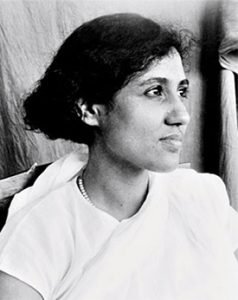
 Dr Rashid Jahan (1905–1952) was a physician, Urdu writer, and political activist whose brief but incendiary career reshaped modern Urdu fiction. As a founding member of the Progressive Writers’ Association (PWA) and a committed member of the Communist Party of India (CPI), she used her dual vocations to champion the rights of women and the underprivileged. Often described as “Urdu literature’s first angry young woman,” she paved the way for a generation of writers, most notably Ismat Chughtai, to explore themes of social and domestic oppression.
Early Life and the Angarey Controversy
Born in Aligarh, Rashid Jahan was the eldest daughter of Sheikh Muhammad Abdullah, a pioneering advocate for women’s education who established the first girls’ school for Muslims in North India. Raised in an intellectually vibrant household, she studied at Isabella Thoburn College before earning her MBBS from Lady Hardinge Medical College in 1929. While serving in the Provincial Medical Service in Lucknow, she joined a radical circle of young writers.
Their collaboration resulted in the 1932 publication of Angarey (Burning Coals). Rashid Jahan contributed a short story, “Dilli ki Sair,” and a play, “Parde ke Peeche,” which exposed the health crises and domestic claustrophobia faced by women in purdah. The anthology’s critique of religious orthodoxy sparked a massive uproar; fatwas were issued, and the British government banned the book in 1933. As the only woman contributor, Rashid Jahan faced intense personal attacks and threats of disfigurement, yet she refused to retreat from the public eye. This controversy became the catalyst for the formal establishment of the PWA in 1936, a movement in which she played a central organisational role.
A Legacy of Medicine and Radical Realism
Rashid Jahan’s literary style was revolutionary, utilising colloquial, everyday language rather than the ornate Urdu prose of the era. Her writing tackled taboo subjects, including women’s sexual health, the physical toll of repeated pregnancies, and the hypocrisy of the patriarchal elite. Her only book published during her lifetime was Aurat aur Digar Afsane (1937), though she wrote dozens of stories and plays, many of which were broadcast on All India Radio or published posthumously in collections like Shola-e-Jawwala (1974).
In 1934, she married fellow activist Mahmuduzzafar and moved to Amritsar and later Dehradun. She balanced her medical practice with deep political engagement, co-editing the Communist journal Chingari and organising free medical clinics and literacy classes for impoverished and lower-caste communities. An active member of the Indian People’s Theatre Association (IPTA), she famously donated the bulk of her earnings to the CPI, living a modest life in a home that doubled as a commune for activists.
Rashid Jahan’s life was cut short by uterine cancer. She travelled to Moscow for treatment but passed away at the Kremlin Hospital on 29 July 1952. She was buried in Moscow under a headstone that succinctly captured her identity: “Rashid Jahan: Communist Doctor and Writer.” Through her unflinching realism, she carved out a critical space in Urdu literature for women to speak openly about their bodies and the social structures that constrained them.