
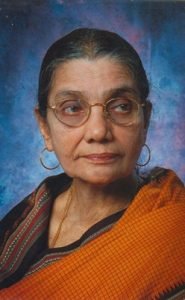
 Sara Aboobacker (1936–2023) was a pioneering Kannada writer and feminist whose work foregrounded the experiences of marginalised Muslim women in South India. She is celebrated as one of the first Muslim women to write in Kannada and was instrumental in shaping contemporary feminist literature within the language.
Born on June 30, 1936, in Kasaragod, Kerala, Sara was raised in a progressive Muslim family. Her father, Pudiyapuri Ahmad, an advocate, ensured she received a formal education—an unusual choice for Muslim girls in her community during that era. In 1953, Sara became the first Muslim girl in South India to complete matriculation. At 16, she married M. Aboobacker, an engineer, and settled in Mangaluru, where they had four sons. Though she aspired for higher education, community restrictions curtailed her ambitions.
Sara began her literary journey at age 45, motivated by an incident involving a fatwa against Muslim women watching movies. She published her first article in the progressive Kannada weekly Lankesh Patrike in 1981, and her association with its founder, P. Lankesh, was pivotal in her development as a writer. Her straightforward, unembellished writing style emphasised authenticity and social critique over literary ornamentation.
Major Works:
Her debut novel, Chandragiriya Teeradalli (On the Banks of Chandragiri, 1981), remains her seminal work. The story of Nadira—a Muslim woman struggling against patriarchal norms—addressed sensitive issues like triple talaq, nikah halala, and domestic violence, drawing from real experiences in her community. The novel provoked controversy, facing criticism and social ostracism from orthodoxy, but also earned critical acclaim. It was later translated into several languages, including English (Breaking Ties).
Other significant novels include Sahana (1985), Vajragalu (1988), Kadana Viraama (1991), Suliyalli Sikkavaru (1994), Tala Odeda Doniyali (1997), and Panjara (2004). Her collections of short stories, notably Chappaligalu (1989) and Sumayya (2004), as well as her translations of major Malayalam works into Kannada, further exemplify her literary reach.
Sara also established her own publishing house, Chandragiri Prakashan, to promote regional literature and maintain creative control over her work.
Themes and Influence:
Aboobacker’s writing is characterised by its themes of gender inequality, patriarchal oppression, the need for religious reform, and the importance of education in empowering women. She advocated for secularism and social justice, highlighting the struggles and resilience of Muslim women, especially from the Beary community.
Her works are widely studied in academic circles and have been included in university syllabi, influencing generations of students and scholars.
Awards and Recognition:
Sara Aboobacker’s literary achievements were recognised with numerous prestigious awards, including the Karnataka Sahitya Akademi Award (1984), the Karnataka Rajyotsava Award (1995), the Daana Chintamani Attimabbe Award (2001), and honorary doctorates from eminent universities, among others.
Sara Aboobacker passed away on January 10, 2023. She is remembered as a fearless voice for women’s rights and social reform, whose legacy endures through her novels and the writers she inspired. Her works continue to resonate in the fields of literature, feminism, and social justice in India.