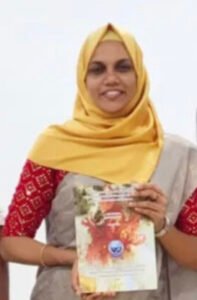
 Shabeena M., born around 1989 on the coral atoll of Androth in Lakshadweep, emerged as a pioneering figure in marine science despite significant early-life challenges. Following the death of her father during her primary school years, she faced an uncertain future, yet she remained committed to her education. She completed both her undergraduate and postgraduate studies within the Lakshadweep archipelago, remarkably standing as the sole woman in her graduating cohort of four. Throughout her academic journey, Shabeena frequently encountered social resistance from relatives and neighbors who questioned the utility of a woman studying aquaculture and microbiology. She met this scepticism with a determined, decades-long pursuit of scientific excellence.
In 2014, Shabeena began her professional career as a fisheries teacher in Androth, marking her as one of the few women in Lakshadweep’s marine sector. However, her aspirations extended toward high-level research. Encouraged by biologist K. K. Idreesbabu and supervised by Professor S. Sureshkumar of the Kerala University of Fisheries and Ocean Studies (KUFOS), she enrolled in a doctoral program in 2016. By 2017, she had formally launched a rigorous fieldwork program, balancing her academic requirements at KUFOS with an affiliation at the Department of Science and Technology in Kavaratti.
Fieldwork and Ecological Discoveries
Shabeena’s doctoral research was both physically demanding and logistically complex. Her fieldwork covered twelve islands—ten inhabited and two uninhabited—where she conducted extensive surveys ranging from intertidal zones to depths of twenty-five meters. Utilising both snorkelling and SCUBA diving, she meticulously mapped the distribution, zonation, and community structures of marine macroalgae across various geomorphological zones, including lagoons and reef slopes. This research often required her to travel across the archipelago to Kochi, sometimes accompanied by her infant daughter and supported by her husband and family.
On November 5, 2024, Shabeena defended her thesis, “Zonation Patterns, Composition and Diversity of Macroalgal Communities in the Lakshadweep Archipelago,” making history as the first woman from Lakshadweep to earn a PhD in marine sciences. Her findings were significant: she recorded 65 species from 22 families across the phyla Rhodophyta, Chlorophyta, and Phaeophyta. Crucially, her work identified seven species previously unrecorded in the archipelago, including Botryocladia pseudodichotoma and Valonia ventricosa.
Conservation and Scientific Legacy
Beyond discovery, Shabeena’s research highlighted a sobering ecological decline. Of the 182 macroalgal species historically recorded in Lakshadweep, her surveys could only locate 96. This contraction was attributed to environmental stressors, including marine sand extraction, coral degradation, and climate change impacts on seagrass beds. Her comprehensive, updated checklist of marine macroalgae was subsequently adopted by the Lakshadweep administration as an official reference for conservation and management.
Shabeena’s contributions have been recognised both academically and through public honours. After publishing preliminary findings in the Journal of the Marine Biological Association of India in 2023, she received the Sanctuary Nature Foundation Wildlife Service Award in 2024. Today, she continues to advance marine science through the molecular study of microalgae. Alongside fellow researcher Mariyambi P. C., Shabeena stands as a trailblazer for women in the region, transforming the landscape of marine biodiversity research in India’s island territories.