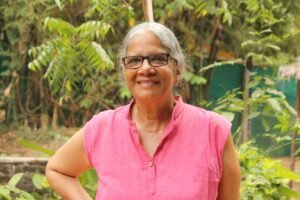
 Zahida Futehally, known professionally as Zai Whitaker, is a prominent Indian naturalist, conservationist, educator, and author. Her career, spanning over forty years, is defined by a unique synthesis of institutional wildlife conservation, the empowerment of indigenous communities, and environmental literature. Born in Mumbai into the distinguished Tyabji lineage, Whitaker was raised in an environment steeped in natural history. Her father, Zafar Futehally, was a central figure in the Bombay Natural History Society and WWF India, while her mother, Laeeq, was an accomplished writer and naturalist. Notably, Whitaker was mentored from a young age by her maternal relative, the legendary ornithologist Dr Salim Ali, whose field walks helped shape her lifelong commitment to the natural world.
Institutional Foundations and Herpetology
In 1974, she married herpetologist Romulus Whitaker. Together, they became a formidable force in reptile conservation, co-founding the Madras Crocodile Bank Trust and Centre for Herpetology near Chennai. This institution evolved into one of India’s premier centres for herpetological research and public education. Whitaker’s early work also included significant herpetological surveys in the Andaman Islands, which eventually led to the creation of the Andaman and Nicobar Environment Team (ANET). Even after her marriage ended, she remained a pivotal figure in these organisations, later serving as the Managing Trustee of the Crocodile Bank. Her family’s influence on global conservation was uniquely immortalised when two Indian lions at the Jersey Wildlife Preservation Trust were named Zafar and Zahida in honour of her father and herself. This legacy of conservation continues through her sons, Nikhil and Samir, who both pursue careers in wildlife management and biology.
Indigenous Advocacy and Social Justice
Whitaker’s work is characterised by a deep-seated concern for environmental justice and the rights of Adivasi communities. In 1987, she co-founded the Irula Tribal Women’s Welfare Society (ITWWS) in Tamil Nadu. The society was established to protect and document the Irula people’s vast, traditional knowledge of medicinal plants and zoology—knowledge Whitaker has described as a “Pandora’s box” of irreplaceable information threatened by modernisation. By organising women across hundreds of villages, the ITWWS has successfully created sustainable livelihoods through herbal production and secured formal education for Irula children. This intersection of social welfare and ecological preservation has earned the society international acclaim for its model of community empowerment.
Literary Career and Educational Leadership
In parallel with her activism, Whitaker has maintained a prolific career as an educator and writer. She spent eighteen years teaching English at Kodaikanal International School and served as principal of the Outreach School in Bangalore, often using wildlife narratives to instil environmental ethics in her students. Her literary output exceeds twenty books, ranging from poetry and biography to award-winning children’s fiction. Key works include Andamans Boy, Kali and the Rat Snake, and the biography Snakeman (revised as Scaling Up). Her 2023 novel, Termite Fry, offers a poignant look at three generations of an Irula family navigating the impacts of the Wildlife (Protection) Act of 1972. Through her writing, Whitaker bridges the gap between scientific observation and literary storytelling, remaining a vital voice for the protection of India’s biodiversity and its traditional guardians.