
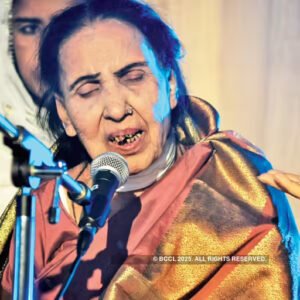
 Zareena Begum (1930–2018), also rendered as Zarina Begum, was a singular figure in Hindustani classical music, widely regarded as the last of the court singers of Awadh. A devoted disciple of the legendary Begum Akhtar, Zareena was a master of baithak gayaki—an intimate, salon-style vocal tradition that flourished in the aristocratic mehfils of Lucknow, Delhi, and Varanasi. Her vast repertoire spanned ghazal, thumri, dadra, and tappa, as well as the soulful poorbi genres of the Awadhi region.
Early Training and Royal Patronage
Born in Nanpara, Uttar Pradesh, Zareena’s musical journey began under the guidance of her father, Shahenshah Hussain, a local qawwal. Her childhood was defined by a clandestine passion for the harmonium until her father recognised her talent and arranged for her to receive formal training with Ghulam Hazrat of Firangi Mahal. She later refined her skills at the Bhatkhande Music Institute. Zareena’s professional and personal life merged when she married Qurban Hussain, a tabla player who frequently accompanied Begum Akhtar.
During the 1950s and 1960s, Zareena rose to prominence as a preferred performer for the nobility of Nanpara, Mehmoodabad, and Rampur. Operating within the conservative traditions of the era, she often sang in purdah for the queens and princesses of the royal households. Her career reached a turning point when Begum Akhtar heard her perform in Bahraich. Deeply moved by Zareena’s voice, the “Queen of Ghazal” took her on as a shagird (disciple). Under this prestigious mentorship, Zareena became a fixture at Lucknow’s most elite royal residences, such as Sultanat Manzil and Sheesh Mehal. Experts like Ustad Iqbal Ahmad Khan noted that Zareena possessed a rare ability to replicate the nuances of Begum Akhtar’s style with breathtaking fidelity.
Musical Contributions and a Fading Legacy
Beyond the courts, Zareena was a regular broadcaster for All India Radio (AIR) Lucknow and performed across India’s major cultural hubs. She is perhaps best remembered for her rendition of the Bhairavi dadra, “Hamari Atariya Pe Aao Sanwariya,” a staple of the Lucknow style that later influenced popular cinema. She also collaborated with filmmaker Muzaffar Ali and was featured in Saba Dewan’s documentary The Other Song (2009), which sought to preserve the vanishing art of the darbari gayika (court singer).
The abolition of the princely states led to a sharp decline in Zareena’s fortunes. Following the death of her husband, she spent her final decades in poverty in a small room in Old Lucknow. In 2013, cultural activist Manjari Chaturvedi helped bring Zareena back to the stage for a final, poignant performance at the IGNCA in New Delhi, titled “The Last Song of Awadh.” In recognition of her lifelong dedication, the Government of Uttar Pradesh honoured her with the inaugural Begum Akhtar Award in 2015.
Zareena Begum passed away on May 12, 2018. Having left no disciples, she died, marking the end of a direct lineage to the Nawabi musical culture. Today, she is remembered not only for her vocal brilliance but also as a symbol of the displacement of traditional female artists in post-independence India.